Welcome to Doris Stoppacher's personal webpage
Personal research and project web page
Curriculum Vitae D. Stoppacher
— —
About: Hi, I’m Doris, a computational astrophysicist working on galaxy formation modelling. I study how galaxies form and how the Universe evolves on its largest scales.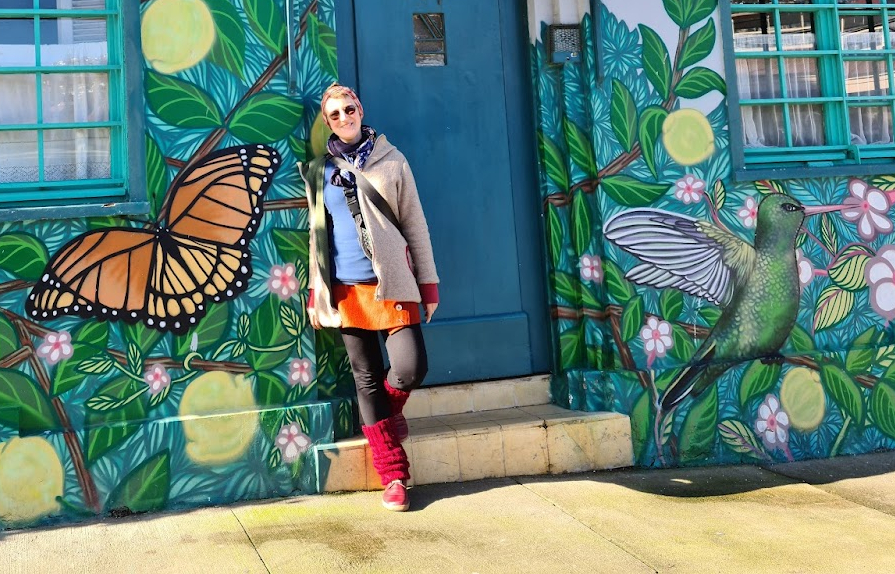
I am a computational astrophysicist (PhD, Universidad Autónoma de Madrid, Spain, December 2019) specialising in galaxy formation and evolution, with a strong focus on methodological innovation, open and data-driven science, and the development of reproducible tools for the astronomical community.
My scientific career spans multiple countries and research environments. Originally from the small Austrian town of Weiz, my early background was in business administration, information technology, and software development. I later made a decisive shift to physics and astrophysics at the Karl-Franzens University of Graz, where I graduated in 2013.
I moved to Spain for my PhD and spent five years in Madrid (2015–2020). I then held my first postdoctoral position at the University of California, Santa Cruz (2020–2021), before being awarded a Margarita Salas Fellowship in 2021 for the project "Hidden Figures in the Sky, which brought me to the Pontificia Universidad Católica de Chile in Santiago for two years (2022–2024).
Since 2024, I have been a member of the Computational Astrophysics group at the Universidad de Sevilla (Spain). I am involved in international collaborations across Europe, the Americas, and China. Since 2025, I have been an external collaborator at the International University of Valencia.
My research combines cosmological simulations, machine learning, and data-intensive analyses to investigate how galaxies form and evolve across the full mass and surface-brightness spectrum. In particular, I focus on what I refer to as “The Extremes” of galaxy formation, ranging from diffuse Low-Surface Brightness Galaxies to Bright Cluster Galaxies. Although these systems occupy opposite ends of the galaxy population, they arise from the same underlying physical processes -- produced by the same Universe -- making them powerful laboratories for understanding galaxy assembly and the formation of large-scale structure in the cosmos.
I am strongly committed to cultural equity and inclusion in science. I am a member of Astronomers for Planet Earth (A4E) and the Sociedad Española de Astronomía (SEA). Teaching is a central part of my work, and I enjoy engaging students by making complex topics accessible through creative and innovative approaches. Alongside my research, I actively participate in outreach activities, regularly giving talks in schools and serving as a “women in science” representative to promote inclusion and visibility.
In recognition of my scientific work and community engagement, I was named Physicist of the Month by the Austrian Physical Society in 2025. Outside academia, I am actively involved in comedy presentation and improvisational theatre, which strongly informs my communication style and creative approach to science.
My scientific career spans multiple countries and research environments. Originally from the small Austrian town of Weiz, my early background was in business administration, information technology, and software development. I later made a decisive shift to physics and astrophysics at the Karl-Franzens University of Graz, where I graduated in 2013.
I moved to Spain for my PhD and spent five years in Madrid (2015–2020). I then held my first postdoctoral position at the University of California, Santa Cruz (2020–2021), before being awarded a Margarita Salas Fellowship in 2021 for the project "Hidden Figures in the Sky, which brought me to the Pontificia Universidad Católica de Chile in Santiago for two years (2022–2024).
Since 2024, I have been a member of the Computational Astrophysics group at the Universidad de Sevilla (Spain). I am involved in international collaborations across Europe, the Americas, and China. Since 2025, I have been an external collaborator at the International University of Valencia.
My research combines cosmological simulations, machine learning, and data-intensive analyses to investigate how galaxies form and evolve across the full mass and surface-brightness spectrum. In particular, I focus on what I refer to as “The Extremes” of galaxy formation, ranging from diffuse Low-Surface Brightness Galaxies to Bright Cluster Galaxies. Although these systems occupy opposite ends of the galaxy population, they arise from the same underlying physical processes -- produced by the same Universe -- making them powerful laboratories for understanding galaxy assembly and the formation of large-scale structure in the cosmos.
I am strongly committed to cultural equity and inclusion in science. I am a member of Astronomers for Planet Earth (A4E) and the Sociedad Española de Astronomía (SEA). Teaching is a central part of my work, and I enjoy engaging students by making complex topics accessible through creative and innovative approaches. Alongside my research, I actively participate in outreach activities, regularly giving talks in schools and serving as a “women in science” representative to promote inclusion and visibility.
In recognition of my scientific work and community engagement, I was named Physicist of the Month by the Austrian Physical Society in 2025. Outside academia, I am actively involved in comedy presentation and improvisational theatre, which strongly informs my communication style and creative approach to science.
— —