Welcome to Doris Stoppacher's personal webpage
Personal research and project web page
Projects and Publications
About: This page provides an overview of my current and past research projects, along with a complete list of my publications.
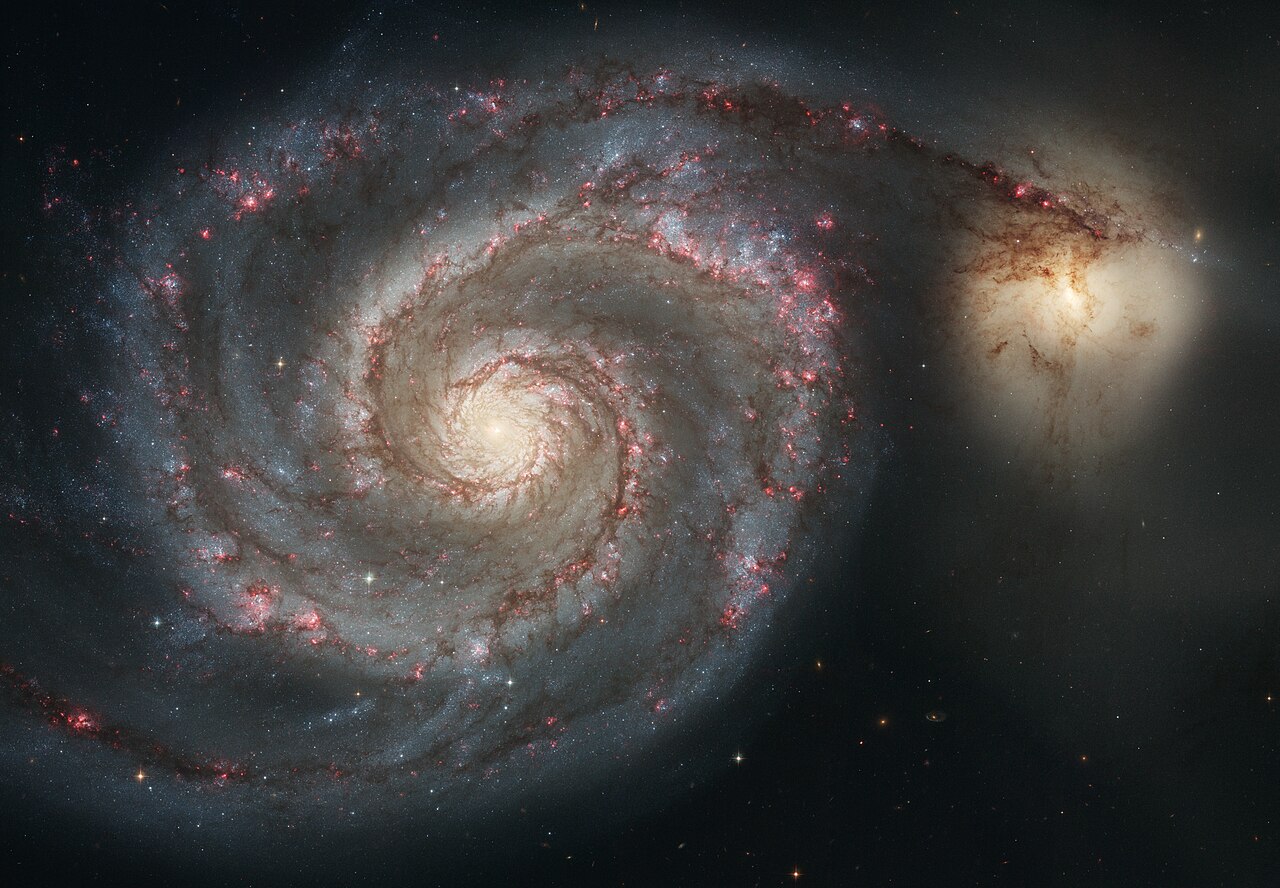
The Whirlpool Galaxy, a classic spiral galaxy located in the Canes Venatici constellation, and its companion NGC 5195 (NASA and European Space Agency)
Projects
Hidden Figures in the Sky
This project investigates the Universe’s faintest and most elusive galaxies. By combining cosmological simulations and data-driven analysis, the project reveals how low-surface-brightness galaxies (LSBGs) form and evolve within their dark matter halos. Once hidden by observational limits, these galaxies are now recognised as key to understanding galaxy evolution.
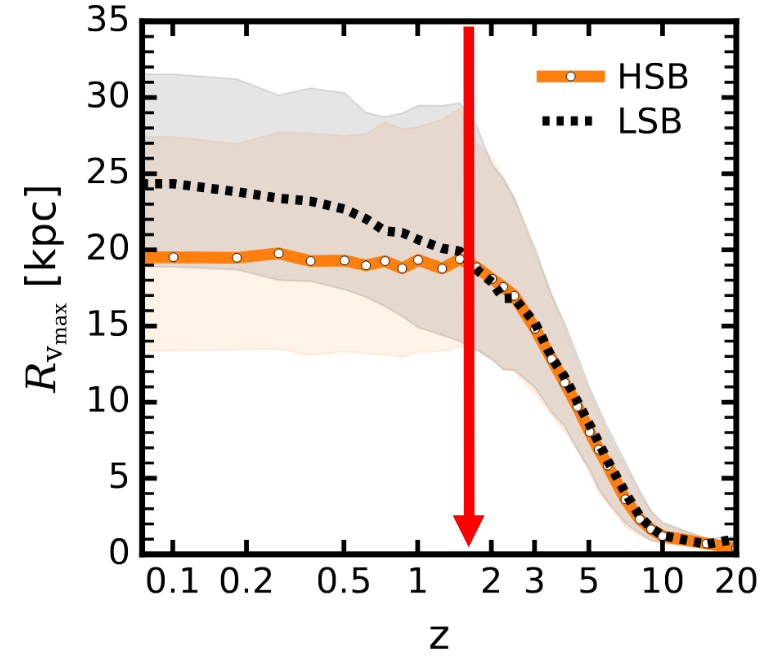
We developed a simple and robust method to estimate surface-brightness densities in hydrodynamical simulations even when full photometric information is unavailable. Using a strict stellar and halo mass selection, we obtained an unbiased comparison between low- and high-surface-brightness galaxies. We show that LSBGs follow more complex evolutionary pathways than previously assumed and introduce a new diagnostic based on the radius at maximum stellar circular velocity (RVmax). This evolutionary track, presented for the first time, reveals a clear divergence between LSBGs and HSBGs at z∼1.5, marking the onset of fundamentally different assembly histories and identifying RVmax as a powerful tracer of LSBG progenitors. The figure shows the redshift evolution RVmax for LSBGs (black dashed) and HSBGs (orange solid). Adapted from Stoppacher et al. 2025.
The Multi-Dark Galaxies
The MultiDark-Galaxies (MD-Galaxies) are feature-rich catalogues generated from 3 independent semi-analytical models of galaxy formation and evolution (SAMs) applied to the 1 h-1Gpc MultiDark Planck 2 simulation (MDPL2, Klypin et al. 2016). These catalogues remain among the largest publicly available SAM datasets. For this project, I combined and processed several terabytes of simulation outputs and carried out all preparation, testing, and data-reduction steps required for their public release as MD-Galaxies. My work included pipeline development (publicly available on GitHub), validation and consistency checks, and full documentation. I ensured that the catalogues were scientifically robust, reproducible, and publicly accessible and continued to provide technical and scientific support to users, helping to maintain the long-term value and usability of these community data products.
Publications
-
A semi-analytical perspective on massive red galaxies: I. Assembly history, environment, and redshift evolution
Stoppacher, D.; Montero-Dorta, A.D.; Artale, M.C.; Knebe, A.; Padilla, N.; Benson, A.J.; Behrens, C.
A&A, 2025 — Link to paper -
Hidden figures in the sky: Evolution of low-surface-brightness galaxies from a hydrodynamical perspective
Stoppacher, D.; Tissera, P.; Rosas-Guevara, Y.; Galaz, G.; Oñorbe, J.
A&A, 2025 — Link to paper -
Characterizing the ELG luminosity functions in the nearby Universe
Favole, G.; Gonzalez-Perez, V.; Ascasibar, Y.; Corcho-Caballero, P.; Montero-Dorta, A.D.; Benson, A.J.; Comparat, J.; Cora, S.A.; Croton, D.; Guo, H.; Izquierdo-Villalba, D.; Knebe, A.; Orsi, Á.; Stoppacher, D.; Vega-Martínez, C.A.
A&A, 2024 — Link to paper -
[O II] emitters in MultiDark-Galaxies and DEEP2
Favole, G.; Gonzalez-Perez, V.; Stoppacher, D.; Orsi, Á.; Comparat, J.; Cora, S.A.; Vega-Martínez, C.A.; Stevens, A.R.H.; Maraston, C.; Croton, D.; Knebe, A.; Benson, A.J.; Montero-Dorta, A.D.; Padilla, N.; Prada, F.; Thomas, D.
MNRAS, 2020 — Link to paper -
El observatorio astronómico de la UAM
Castrillo, A.; Zamora, S.; Rodríguez-Baras, M.; Cortés-Contreras, M.; Rebollido, I.; Corcho, P.; Millán, I.; Stoppacher, D.; Mérida, R.M.; Díaz, A.I.; Ascasibar, Y.
Conference proceeding, 2020 — Link to paper -
Astro en casa
Cortés-Contreras, M.; Castrillo, A.; Rebollido, I.; Rodríguez-Baras, M.; Stoppacher, D.; Zamora-Arenal, S.
Conference proceeding, 2020 — Link to paper -
MULTIDARK-GALAXIES: data release and first results
Knebe, Alexander; Stoppacher, Doris; Prada, Francisco; Behrens, Christoph; Benson, Andrew; Cora, Sofia A.; Croton, Darren J.; Padilla, Nelson D.; Ruiz, Andrés N.; Sinha, Manodeep; Stevens, Adam R.H.; Vega-Martínez, Cristian A.; Behroozi, Peter; Gonzalez-Perez, Violeta; Gottlöber, Stefan; Klypin, Anatoly A.; Yepes, Gustavo; Enke, Harry; Libeskind, Noam I.; Riebe, Kristin; Steinmetz, Matthias
MNRAS, 2018 — Link to paper -
The Three Hundred project: a large catalogue of theoretically modelled galaxy clusters for cosmological and astrophysical applications
Cui, Weiguang; Knebe, Alexander; Yepes, Gustavo; Pearce, Frazer; Power, Chris; Dave, Romeel; Arth, Alexander; Borgani, Stefano; Dolag, Klaus; Elahi, Pascal; Mostoghiu, Robert; Murante, Giuseppe; Rasia, Elena; Stoppacher, Doris; et al.
MNRAS, 2018 — Link to paper
Once you took the first step, anything was possible.
— Katherine Johnson, NASA Mathematician