Welcome to Doris Stoppacher's personal webpage
Personal research and project web page
Projects & Publications
About: This page provides an overview of my current and past research projects, along with a complete list of my publications.
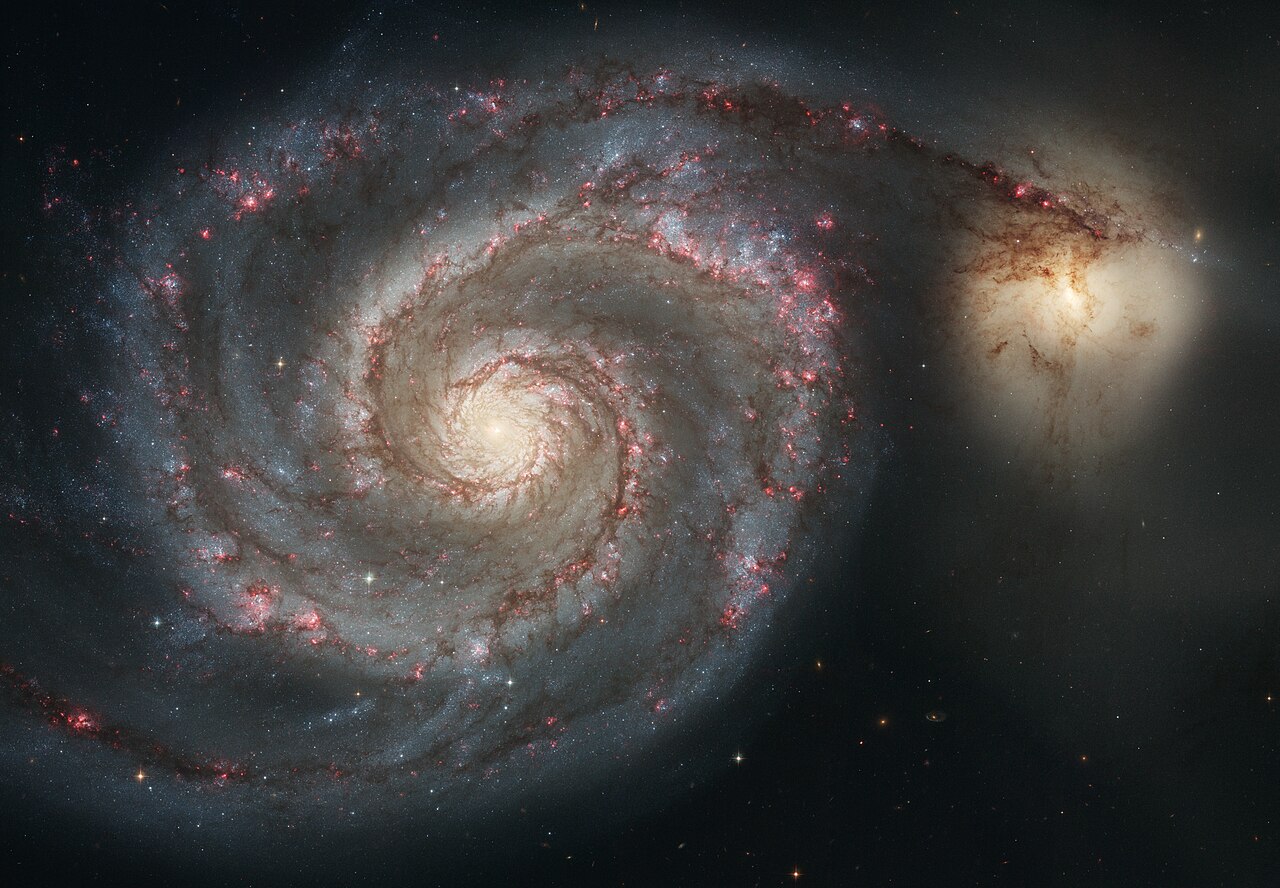
The Whirlpool Galaxy, a classic spiral galaxy located in the Canes Venatici constellation, and its companion NGC 5195 (NASA and European Space Agency)
Projects
Hidden Figures in the Sky
Low-surface-brightness galaxies in cosmological simulations
This project explores the formation and evolution of low-surface-brightness galaxies (LSBGs / LSBs). This fascinating yet poorly understood population remains underrepresented in the literature despite its potential to reshape our understanding of galaxy formation. Using cosmological hydrodynamical simulations, I investigate how these faint galaxies form and evolve, and develop new methods to identify and characterise them in simulated data, connecting their observable properties to their underlying dark matter haloes.
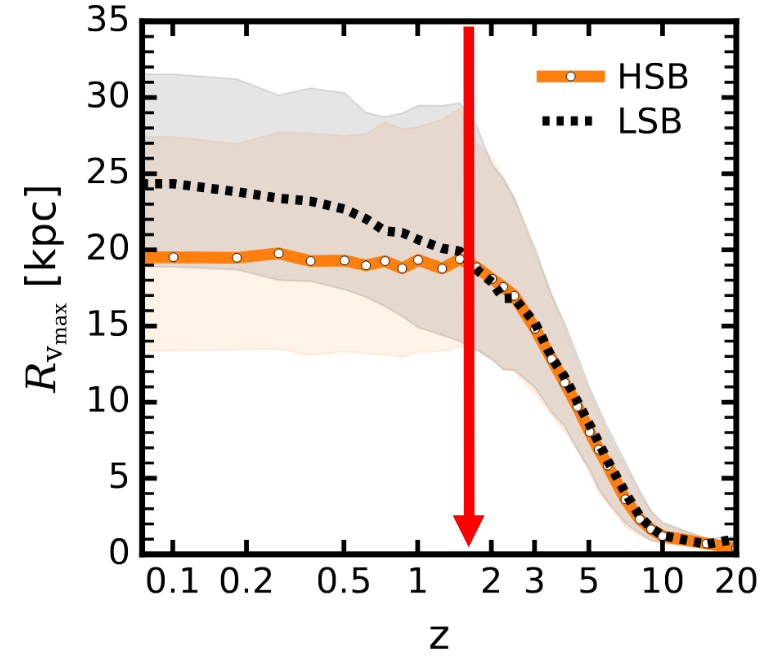
In Stoppacher et al. (2025b), we investigated the evolutionary pathways of LSBs and found that their assembly histories are considerably more complex than previously assumed. We introduced a novel diagnostic based on the radius at which the stellar circular velocity reaches its maximum, Rvmax, which has not previously been used in the literature to characterise LSB galaxies. This provides a unique probe of the evolution of their inner halo structure across cosmic time.
The figure reveals a clear divergence in Rvmax at z~1.5 (red arrow) between LSBs (black dashed line) and high-surface-brightness galaxies (HSBs; orange solid line with white dots), marking it the strongest separation between the evolutionary pathways of the two populations identified in our analysis.
Figure adapted from Stoppacher et al. (2025b).
The MultiDark-Galaxies
Modelled galaxies and their evolution on the largest-scale
The MultiDark-Galaxies project provides a comprehensive view of galaxy formation within the cosmic web by combining large cosmological simulations with semi-analytical models of galaxy evolution (SAM). We developed and released publicly available galaxy catalogues and analysis tools, enabling researchers to explore the connection between galaxies and their dark matter environments across cosmic time.
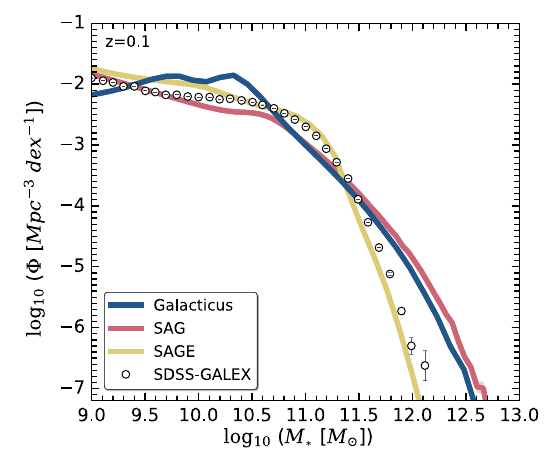
The MultiDark-Galaxies are feature-rich catalogues generated from three independent SAMs applied to the 1 h-1Gpc MultiDark Planck 2 dark matter-only simulation Klypin et al. 2016. These catalogues remain among the largest publicly available SAM datasets.
We provide scientifically robust, reproducible, and publicly accessible galaxy catalogues, along with technical and scientific support to users, helping maintain the long-term value and usability of these community data products via the platforms Skies&Universes and COSMOSIMS.
Figure adapted from Knebe, Stopacher, Prada et al. (2018).
A Semi-Analytical Perspective
Exploring the origin and evolution of the most massive and passive galaxies in the Universe.
By combining semi-analytical galaxy formation models with large cosmological simulations, this research investigates how galaxies grow, quench, and become embedded in increasingly massive dark matter environments. The project offers a complementary perspective on galaxy evolution, linking the observable properties of massive galaxies to their underlying formation histories and halo assembly.
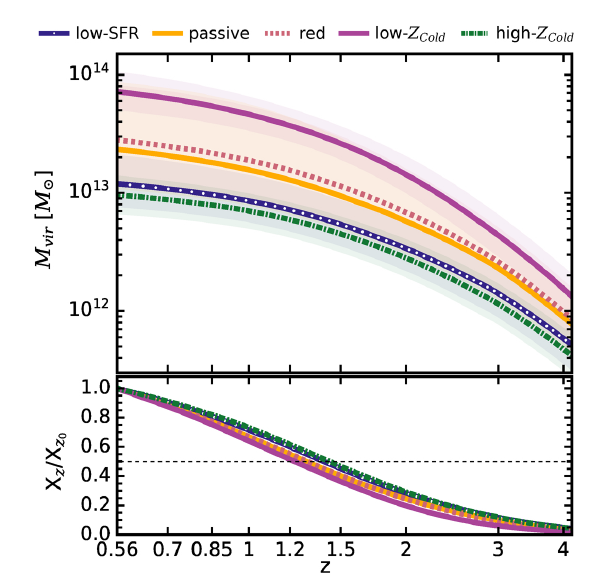
This project investigates the redshift evolution and mass assembly histories of luminous and massive galaxies, with a particular focus on how their evolution depends on environment. Using semi-analytical models, clustering statistics, and the galaxy–halo connection, we trace the evolution of distinct galaxy sub-populations selected at intermediate redshift.
By placing these galaxies within the cosmic web, we explore how the large-scale environment shapes their properties, assembly histories, and evolutionary pathways across cosmic time.
The figure shows the halo mass assembly history (upper panel) and corresponding growth history (lower panel). Massive galaxies are not forming a unified population but are highly diverse within them. Figure adapted from Stoppacher et al. (2025a).
FOGLESS + The Machine
Understanding how galaxies are shaped by their cosmic environment
The Formation Of Galaxies in the LargE Scale Structure (FOGLESS) is a Spanish research collaboration bringing together researchers from multiple universities to bridge computational astrophysics, cosmology, and observations. Within this framework, I designed GalaxyShapeNet, a novel neural-network framework for measuring the three-dimensional shapes of galaxy clusters from their observed galaxy populations. By connecting machine learning with observational data and cosmological simulations, this work develops new tools to probe the structure of the Universe and the role of the cosmic environment in galaxy evolution.
"The Extremes" of galaxy formation and evolution
From Bright Cluster Galaxies to Low-Surface-Brightness Galaxies
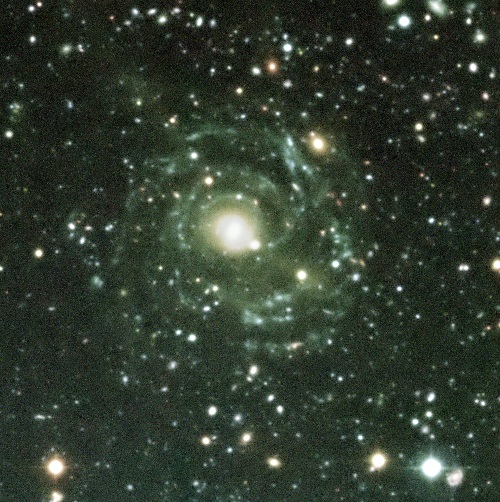
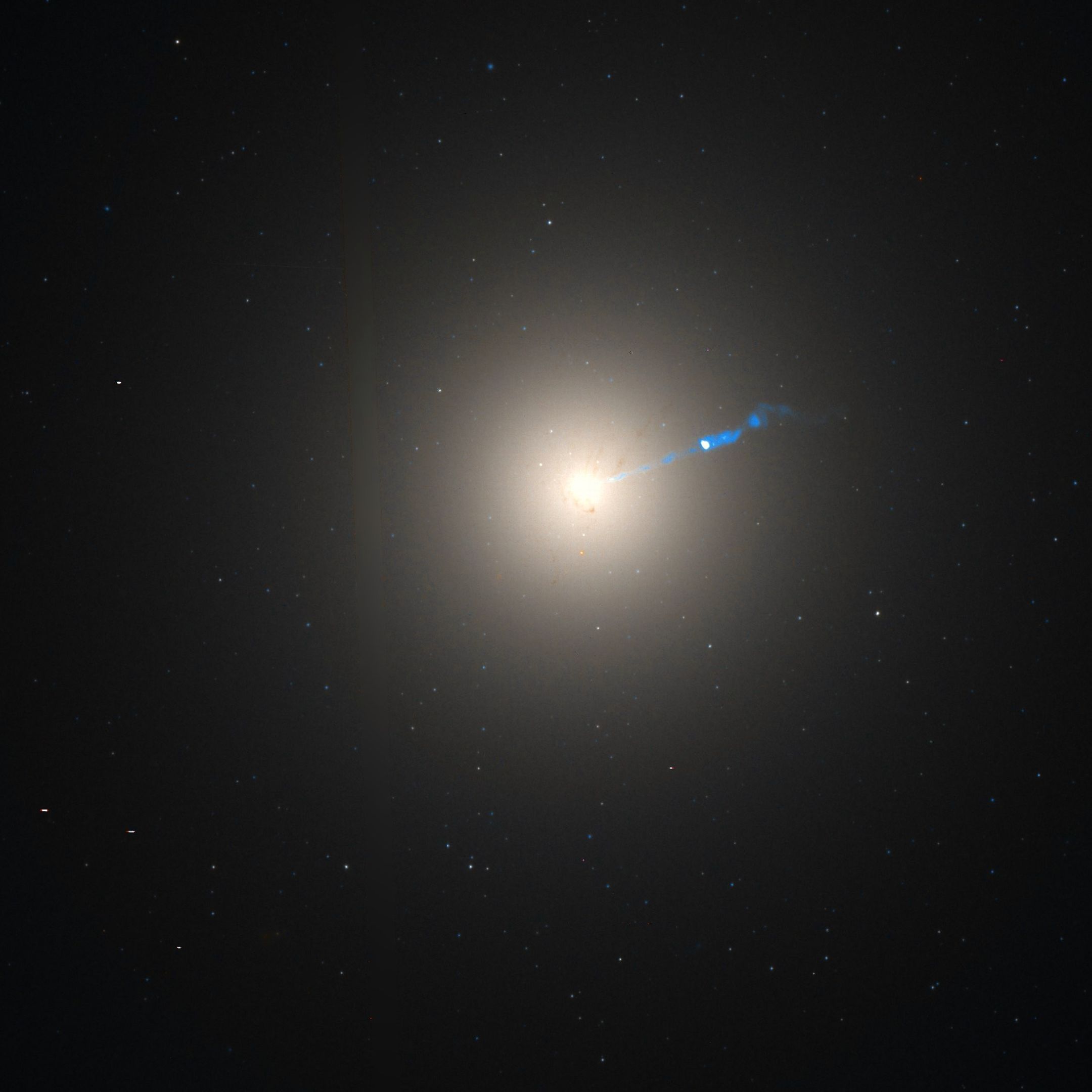
What determines whether a galaxy becomes one of the most massive and dominant systems in the Universe or remains faint, diffuse, and almost invisible? The Extremes brings together two seemingly opposite galaxy populations: Brightest Cluster Galaxies (BCGs) and low-surface-brightness galaxies (LSBGs). By tracing their assembly histories from the early Universe to today, we investigate how the initial conditions and growth of their dark matter haloes steer galaxies toward radically different evolutionary paths. Focusing on the critical epochs at high redshift, when the foundations of present-day galaxies are established, this unified framework aims to uncover the evolutionary turning points that shape the most extreme galaxies in the Universe and to provide new predictions for finding their progenitors in the distant cosmos.
Publications
-
The emergence of the faint nature of low surface brightness galaxies in the IllustrisTNG simulation
Pérez-Montaño, Luis Enrique; Cervantes Sodi, Bernardo; Rodríguez-Goméz, Vicente; Stoppacher, Doris; Cao, Tian-Wen
MNRAS, 2026 — Link to paper -
The Journey to Dominance: How Brightest Cluster Galaxies Evolve Differently from Other Massive Galaxies
Vicentin, Marcelo C.; Strauss, Michael A.; Sodré, Jr., Laerte; Yates, Robert M.; Araya-Araya, Pablo; Stoppacher, Doris
ApJ, 2026 — Link to paper -
Hidden figures in the sky: Evolution of low-surface-brightness galaxies from a hydrodynamical perspective
Stoppacher, D.; Tissera, P.; Rosas-Guevara, Y.; Galaz, G.; Oñorbe, J.
A&A, 2025 — Link to paper -
A semi-analytical perspective on massive red galaxies: I. Assembly history, environment, and redshift evolution
Stoppacher, D.; Montero-Dorta, A. D.; Artale, M. C.; Knebe, A.; Padilla, N.; Benson, A. J.; Behrens, C.
A&A, 2025 — Link to paper -
Characterizing the ELG luminosity functions in the nearby Universe
Favole, G.; González-Pérez, V.; Ascasibar, Y.; Corcho-Caballero, P.; Montero-Dorta, A. D.; Benson, A. J.; Comparat, J.; Cora, S. A.; Croton, D.; Guo, H.; Izquierdo-Villalba, D.; Knebe, A.; Orsi, Á.; Stoppacher, D.; Vega-Martínez, C. A.
A&A, 2024 — Link to paper -
[OII] emitters in MultiDark-Galaxies and DEEP2
Favole, G.; González-Pérez, V.; Stoppacher, D.; Orsi, Á.; Comparat, J.; Cora, S. A.; Vega-Martínez, C. A.; Stevens, A. R. H.; Maraston, C.; Croton, D.; Knebe, A.; Benson, A. J.; Montero-Dorta, A. D.; Padilla, N.; Prada, F.; Thomas, D.
MNRAS, 2020 — Link to paper -
El observatorio astronómico de la UAM
Castrillo, A.; Zamora, S.; Rodríguez-Baras, M.; Cortés-Contreras, M.; Rebollido, I.; Corcho, P.; Millán, I.; Stoppacher, D.; Mérida, R. M.; Díaz, A. I.; Ascasibar, Y.
Conference Proceeding, 2020 — Link to paper -
Astro en casa
Cortés-Contreras, M.; Castrillo, A.; Rebollido, I.; Rodríguez-Baras, M.; Stoppacher, D.; Zamora-Arenal, S.
Conference Proceeding, 2020 — Link to paper -
A semi-analytical perspective on massive galaxies at z~0.55
Stoppacher, D.; Prada, F.; Montero-Dorta, A. D.; Rodríguez-Torres, S.; Knebe, A.; Favole, G.; Cui, W.; Benson, A. J.; Behrens, C.; Klypin, A. A.
MNRAS, 2019 — Link to paper -
The Three Hundred project: a large catalogue of theoretically modelled galaxy clusters for cosmological and astrophysical applications
Cui, Weiguang; Knebe, Alexander; Yepes, Gustavo; Pearce, Frazer; Power, Chris; Dave, Romeel; Arth, Alexander; Borgani, Stefano; Dolag, Klaus; Elahi, Pascal; Mostoghiu, Robert; Murante, Giuseppe; Rasia, Elena; Stoppacher, Doris; Vega-Ferrero, Jesús; Wang, Yang; Yang, Xiaohu; Benson, Andrew; Cora, Sofía A.; Croton, Darren J.; Sinha, Manodeep; Stevens, Adam R. H.; Vega-Martínez, Cristian A.; Arthur, Jake; Baldi, Anna S.; Cañas, Rodrigo; Cialone, Giammarco; Cunnama, Daniel; De Petris, Marco; Durando, Giacomo; Ettori, Stefano; Gottlöber, Stefan; Nuza, Sebastián E.; Old, Lyndsay J.; Pilipenko, Sergey; Sorce, Jenny G.; Welker, Charlotte
MNRAS, 2018 — Link to paper -
MULTIDARK-GALAXIES: data release and first results
Knebe, Alexander; Stoppacher, D.; Prada, Francisco; Behrens, Christoph; Benson, Andrew; Cora, Sofia A.; Croton, Darren J.; Padilla, Nelson D.; Ruiz, Andrés N.; Sinha, Manodeep; Stevens, Adam R. H.; Vega-Martínez, Cristian A.; Behroozi, Peter; Gonzalez-Perez, Violeta; Gottlöber, Stefan; Klypin, Anatoly A.; Yepes, Gustavo; Enke, Harry; Libeskind, Noam I.; Riebe, Kristin; Steinmetz, Matthias
MNRAS, 2018 — Link to paper
- — Katherine Johnson, NASA Mathematician